Marvin McInnis challenges the widely held belief that Canadian agriculture was adversely affected by the First World War. His talk at the University of Guelph Rural Roundtable yesterday,
presented a nuanced and revisionary look at the common story that wartime demand drove Canadian farmers to double acreage devoted to wheat and unwittingly create a dangerous monoculture. A situation that led to a massive collapse in GNP when the price of wheat collapsed after the war. McInnis’ earlier paper “Canadian Economic Development in the Wheat Boom Era” sets an appropriate stage for this further discussion. In this paper, McInnis questions the conclusion that Canada’s rapid economic growth during the first decade and a half of the twentieth century rested on western settlement and the ‘wheat boom.’ This has been a persistent and widely accepted view until more recent re-examination has questioned the role of wheat in this growth and determination that other factors were of greater consequence to this growth. This story though has supported the consequent one that envisions wartime demand and response to it as greatly affecting Canada’s agricultural economy.
The latest additions to The Great Unsolved Mysteries in Canadian History Project were published today.
When I took a look at the three new mysteries I was reminded what a powerful addition to the teaching of Canadian history that this collection is. The new mysteries: “The Redpath Mansion Mystery”, “Death on Painted Lake: The Tom Thomson Tragedy,” and “Death of a Diplomat: Herbert Norman and the Cold War” keep raising the bar of how to effectively present material using the web. The project is a collabourative effort amongst Canadian historians to provide engaging and fun teaching tools directed towards high school and university level students. The mysteries are presented as self-contained websites, each one with its own theme and approach. Typically they provide compelling narrative and also offer a wealth of primary documents and other source material to aid in learning about Canadian History and historical methods. With the addition of these new modules, the breadth of the site is reaching a point of critical mass and offer a nicely diverse collection from throughout time and geographic area.
I was entering some dummy citations into a social networked text sharing project on the weekend.
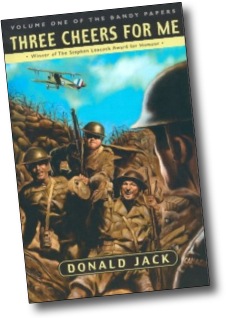
Serendipitously I chose the genre of historical fiction and ended up reflecting on some of the more memorable books I have enjoyed. At the top of that list is the memoirs of Bartholomew Wolfe Bandy by Donald Jack. This multi-volume series was very deservedly awarded the Stephen Leacock Award for humour on three occasions. This is all the more appropriate given the very Leacockian style of the Bandy papers themselves.
If you have not ever been exposed to Bandy, I can not recommend these books enough. They are superb examples of the comedic novelist’s art down the line of P.G Wodehouse, Evelyn Waugh and George Macdonald Fraser. Set in early twentieth century Ontario, B.W. Bandy, the hero is an Ottawa valley farm boy who heads off to fight in the First World War. He meets real life notables along the way, enjoys some of the most brilliantly told adventures and despite the comedic delivery actually teaches much about Canadian history. These novels demonstrate the close connection between literature and history - the enduring importance and beauty of a tale well told.
Read the complete article… »
The Wilson Centre for Canadian History was privileged to have John H Thompson speak today on “Managing in the Bush Leagues: The Canada-US Relationship since 2001.”
Thompson’s lively talk was marked by his personal reflections on what it’s like to be an advising Canadian, one who has moved permanently to the US and on his perspective as a student of United States - Canadian relations from one living in the heart of the beast.
His pithy presentation was enfragranced with a number of well chosen editorial cartoons from both Canadian and American papers and by a couple of rather loaded quotations. His talk was loosely framed by an exploration of the relationship between countries during the presidency of George W Bush, and introduced by a short retrospective of relations between Canadian Prime Ministers and Presidents from Mackenzie King.
Read the complete article… »
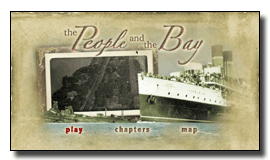
The Wilson Centre in Canadian History officially launched an awesome new learning tool
destined for the classrooms of local schools last night. The People and the the Bay is an historical environmental documentary created by Nancy Bouchier, Ken Cruikshank and the wizards from Pixel Dust Studios This stunning production brings a vivacity, zest, and probing depth to explore the unique relationship between the Hamilton harbour and the lives of people in the area and the city itself. The occasion was celebrated at the Canada Marine Discovery Centre, a uniquely appropriate site for presenting this production. The centre sits on the harbour and is an interpretative museum dedicated to Canada’s rich aquatic heritage.
Read the complete article… »
I attended a SRO lecture by Alan Taylor last week. He delivered a wonderful narrative on the life of Joseph Brant couched in the currently contentious discussion over native land rights in the Grand River basin. Taylor is the author of a variety of books, the most pertinent being The Divided Ground: Indians, Settlers, and the Northern Borderland of the American Revolution.
Following a concise, if rather softly spoken, brief on the various parties playing in the story, he moved to the meat of the matter. The key element that Taylor seemed to want the audience to appreciate was that the Six Nations themselves were by no means homogeneous. Additionally, the area into which they moved was by no means dominated by one party or another and was a populated by a collection of diverse groups already: pre-existing natives such as the Mississauga, recent settlers from either the US or from the British Isles and significantly, a small, but vocal cadre of British military forces. The result is an intermixed culturally diverse people in this area.
Read the complete article… »
The 2007-2008 Wilson series of lectures in Canadian History kicked off at McMaster University today. John Weaver, the acting Wilson Chair in Canadian History, has attracted an exciting list of speakers for the coming year. Lou Pauly spoke on ’Globalization, Political Authority and the
Prevention of Systemic Financial Crises.’ He followed Angela Graham who, less than 24 hours prior to her doctoral defense, provided an engaging look at Canadian Foreign Policy towards the People’s Republic China between the Second World War and recognition in 1970.
Read the complete article… »
Apparently, when the going gets tough, Canadians turn to lawyers. I have semi-arbitrarily qualified the two world wars as national crises (yes, we could argue over what other crises may well have faced the nation, but for sake of simple conjecture I will use these), and examined what occupations emerge amongst our elected representatives. During both world wars, members of the legal profession end up as the dominant non-Parliamentary career in the House of Commons. There is only one other point at which they are the dominant occupational group…
Read the complete article… »
In an earlier post, I pondered the occupational composition of the House of Commons and its implications on policy making. This posts casts an historical gaze on the occupations of MPs at Confederation comparing the structure with the current and hypothesizing about the evolution over the past 160 years.
As I mentioned earlier, I had a sense that lawyers were a more dominant force in earlier times and that business men and women possibly have a more decisive role in policy making today than earlier. This chart:
shows the occupational composition of the Canadian Parliament in 1867.
Read the complete article… »
A colleague and I were discussing an anecdotal perception that there has been a shift from relying on lawyers to craft policy and laws in Canada towards reliance on business. This post ponders how our elected representatives self-identify themselves and what effect their prior occupation might have on their policy making.
This tree chart shows the composition of the current House of Commons by occupational classification:
I am a Digital Humanities Specialist at 


Recent Comments